Single-Zone vs Multi-Zone Mini Splits
Single-zone vs multi-zone mini splits: how many zones one outdoor unit can carry, when two single-zone systems beat one multi-zone, and which of our rated systems fits each layout.


A single-zone mini split pairs one indoor head with one outdoor unit; a multi-zone system runs several heads, each with its own thermostat, off one shared outdoor unit. DOE notes many models support up to four heads, and PNNL generally advises no more than three per outdoor unit. Choose single-zone for one or two rooms or when heads will often be off, multi-zone when wall space outside is limited and the rooms run at the same time.
Affiliate disclosureAs an Amazon Associate we earn from qualifying purchases made through links on this page. Commissions never change our ratings.
How the two layouts differ
| Single-zone | Multi-zone | |
|---|---|---|
| Outdoor units | One per head | One for 2 to 4 heads (some models more) |
| Room control | Its own thermostat | Each head has its own thermostat |
| If the outdoor unit fails | One room loses heating and cooling | Every connected room does |
| Line sets and drains | One run | One run per head |
| Efficiency when rooms are idle | Unaffected | Can drop if heads are switched off (PNNL) |
DOE's Energy Saver page notes that many minisplits support up to four indoor units on one outdoor unit, each zone with its own thermostat, so you condition only occupied rooms. PNNL adds that some models allow as many as eight, but generally recommends not connecting more than three.
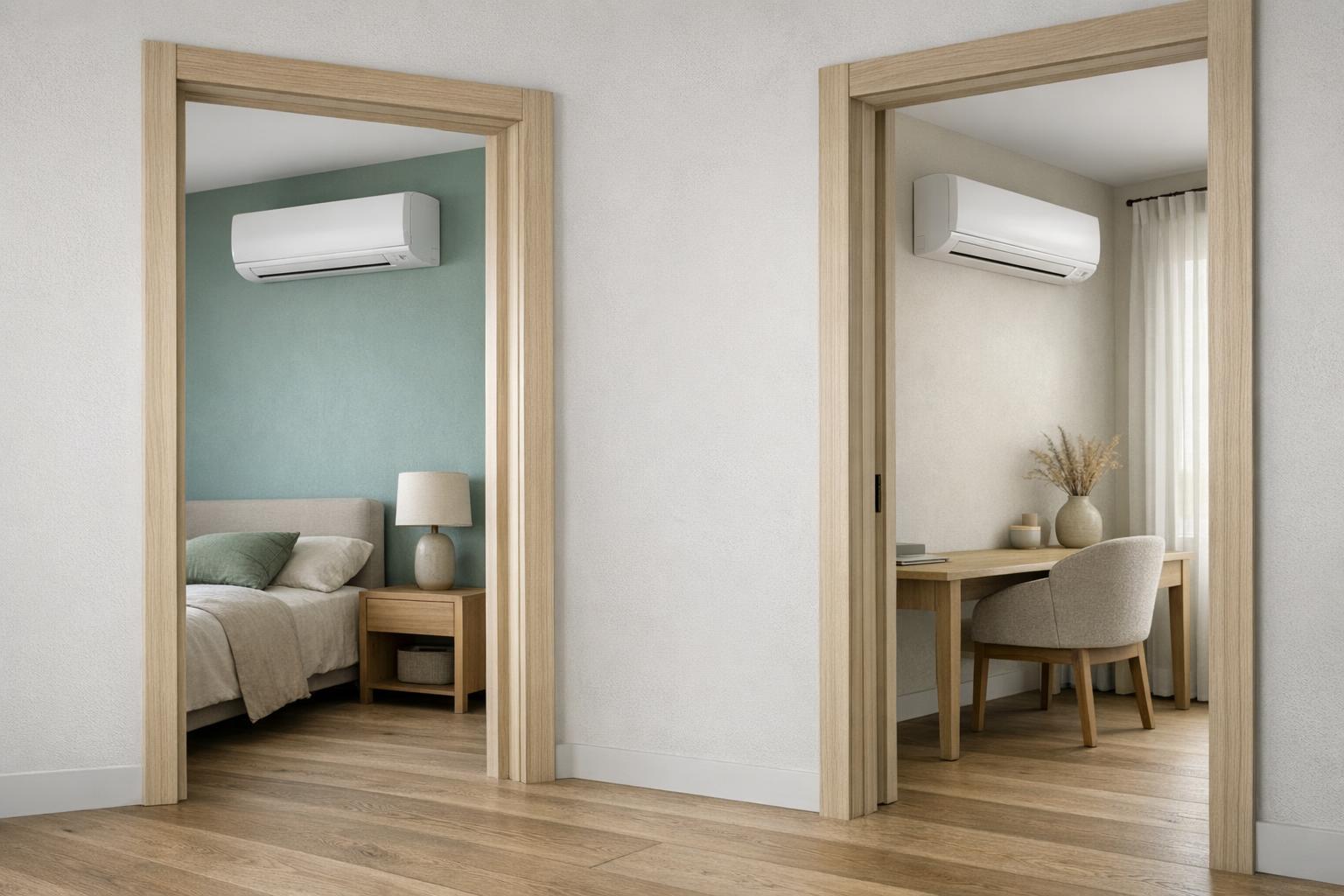
When single-zone is the better call
- You need one or two rooms, and there is space outside for two condensers.
- Some rooms are only used occasionally, so their heads would often be off.
- You want to start with one room and add another later without replacing anything.
- The rooms are on different sides of the house, which would mean long line runs to one unit.
PNNL explains the idle-head problem: turning heads off can drop the load below the outdoor unit's minimum capacity so it cycles on and off, and some refrigerant still flows through an indoor unit that is off. Its suggestion is to group rooms used together on one outdoor unit and occasional rooms on another.
When multi-zone earns its place
Multi-zone makes sense when three or more rooms run at the same hours, such as bedrooms at night, and there is only one good spot for an outdoor unit. It also means one electrical circuit for the condenser instead of several. Size the outdoor unit to the rooms that run together and each head to its own room; PNNL notes that even the smallest heads can be larger than a small room needs, so a head in every room is not automatically right.
Check line lengths early. In the MRCOOL 4th-generation DIY multi-zone manual, each head can be at most 73.8 ft from the condenser and the combined length is capped (123 ft for the 2-zone, 172.2 ft for the 3-zone condenser). Other brands publish their own limits in the installation manual.

Which of our rated systems fits each layout
| Layout | System | What the listing says |
|---|---|---|
| Three bedrooms, one outdoor spot | ROVSUN 3-Zone 28,000 BTU (9K/9K/9K) | 28,000 BTU, three 9,000 BTU heads, 20 SEER2, 25 ft line sets, 208-230V; rated 9.1/10 |
| Two bedrooms and one larger room | ROVSUN 28,000 BTU Tri Zone (9K/9K/12K) | 9K/9K/12K heads, 20 SEER2, Wi-Fi |
| Two rooms of similar size | Albott 2-Zone 12K+12K BTU | 12K + 12K BTU, 25 SEER2 |
| One room | Mountman 12,000 BTU 110/120V | 12,000 BTU, 19 SEER2, 110/120V |
See all ratings in our best multi-zone mini splits and best 12,000 BTU mini splits rankings.
Layout mistakes that cost comfort
- A head in every room by default: PNNL warns that even the smallest heads can exceed what a small bedroom needs, so they short-cycle.
- Rarely used rooms on the main outdoor unit: idle heads can drop the load below the outdoor unit’s minimum; PNNL suggests a separate unit for occasional rooms.
- Line runs past the manual’s limit: each brand caps the length per head and the height difference; MRCOOL’s 4th-generation multi-zone manual allows 32.8 ft between indoor and outdoor unit heights.
- Heads on interior walls without a drain plan: MRCOOL notes that lines then run through an attic, basement or crawlspace, and a condensate pump may be needed.
Rooms without a head of their own
PNNL notes that it often makes no sense to put an indoor unit in every room, because of cost and because even the smallest heads can deliver far more than a small room needs. Rooms without a head can then run warmer in summer and cooler in winter. One option PNNL describes is small air transfer fans that move air between a room with a head and one without; they need a return path, such as a vent between the rooms or undercut doors. Another is a ducted mini split air handler with short duct runs to a few nearby rooms, which must be matched to the outdoor unit like any other indoor unit.
Costs and service
Every extra head adds its own mounting, line set and drain, so a multi-zone job is priced per zone; DOE lists higher installation costs among the disadvantages of minisplits in general. When one outdoor unit fails, every room on it goes down, which matters more if the system is your main heat. Our mini split cost guide breaks down what moves a quote, and line sets and accessories covers the parts list.
Frequently asked questions
How many zones can a mini split have?
DOE notes many models support up to four indoor units on one outdoor unit, and PNNL says some allow up to eight. PNNL generally recommends no more than three heads per outdoor unit.
Is a 2-zone mini split better than two single-zone units?
Not automatically. Two single-zone units keep running independently and avoid the idle-head cycling PNNL describes; a 2-zone system saves wall space outside and one condenser circuit. Choose by how often both rooms run together.
Are multi-zone mini splits less efficient?
They can be when some heads are off: PNNL explains that the load can drop below the outdoor unit's minimum, so it cycles. Grouping rooms that run together on one outdoor unit avoids most of that.
Can I add a zone to a mini split later?
Only if the outdoor unit is a multi-zone model with a free port and enough capacity. A single-zone outdoor unit cannot take a second head; you would add another single-zone system.
Our rated picks
The three best-rated models of our best multi-zone mini splits in 2026 ranking, from the buyer review record and the listed specs.


Product images: Amazon listings
Sources
- U.S. Department of Energy, Energy Saver (archived June 18, 2026) — Ductless Minisplit Heat Pumps (consulted Nov 2026)
- Pacific Northwest National Laboratory, Building America Solution Center — Ductless (Mini-Split) Heat Pumps (consulted Nov 2026)
- MRCOOL (copy hosted by InspectAPedia) — DIY Multi-Zone 4th Gen Installation & Owner's Manual (PDF, version 06-06-2023) (consulted Nov 2026)