Mini Split Sizing: Loads Before BTU Labels
Mini split sizing: the ENERGY STAR square-footage chart, the sun, shade and occupant adjustments, BTU to tons, and why a Manual J load calculation beats any listing claim.

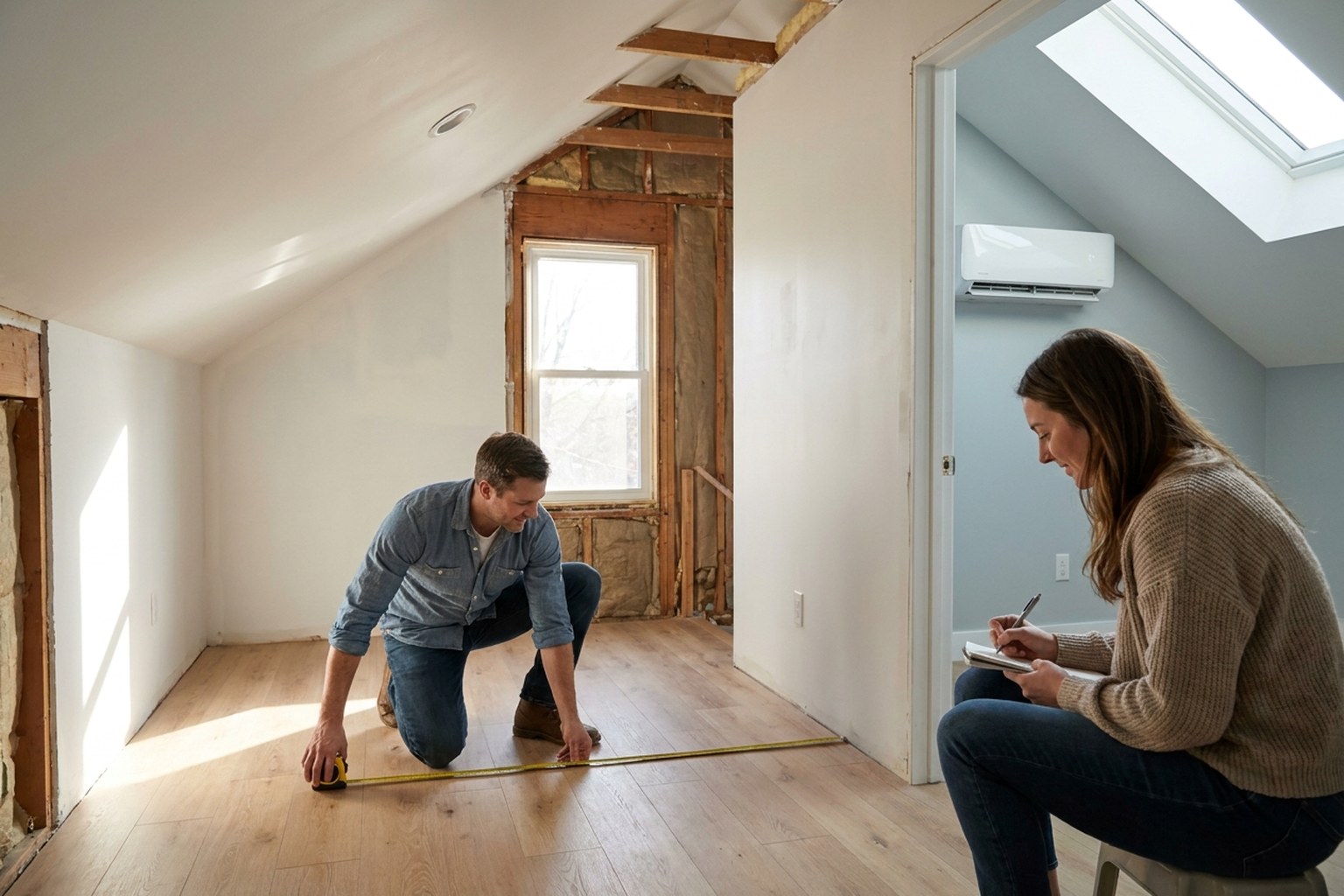
Mini split sizing starts with a room-by-room load, not a square-footage claim on the box. As a first estimate, ENERGY STAR's chart puts 12,000 BTU per hour at 450 to 550 sq ft, 18,000 BTU at 700 to 1,000 sq ft and 21,000 BTU at 1,000 to 1,200 sq ft, with 8 ft ceilings; you then adjust for sun, shade and people. A Manual J calculation by your contractor settles it, and it often lands below what the listing promises.
Affiliate disclosureAs an Amazon Associate we earn from qualifying purchases made through links on this page. Commissions never change our ratings.
The square-footage chart, as a first estimate
| Area to cool | Capacity | In tons |
|---|---|---|
| 250 to 300 sq ft | 7,000 BTU/h | 0.6 |
| 350 to 400 sq ft | 9,000 BTU/h | 0.75 |
| 450 to 550 sq ft | 12,000 BTU/h | 1 |
| 550 to 700 sq ft | 14,000 BTU/h | 1.2 |
| 700 to 1,000 sq ft | 18,000 BTU/h | 1.5 |
| 1,000 to 1,200 sq ft | 21,000 BTU/h | 1.75 |
| 1,500 to 2,000 sq ft | 30,000 BTU/h | 2.5 |
The chart is ENERGY STAR's guide for room air conditioners, which is why it is a sanity check and not a design. One ton is 12,000 BTU per hour; our BTU and tons converter does the conversion both ways.
Adjust for sun, shade, people and kitchens
- Heavily shaded room: reduce capacity by 10%.
- Very sunny room: increase capacity by 10%.
- More than two regular occupants: add 600 BTU per extra person.
- Kitchen: add 4,000 BTU.
- Ceilings above 8 ft: the chart assumes 8 ft, so a taller room needs a closer look.
Those are ENERGY STAR's own adjustments. A sunny 500 sq ft living room with four people therefore lands near 12,000 × 1.1 + 1,200, about 14,400 BTU, which is between the 12,000 and 18,000 BTU sizes most listings offer. That is exactly the case where a proper calculation pays for itself.
What a Manual J calculation adds
ENERGY STAR says your contractor should verify the size with Manual J, a calculation of the heating and cooling your home needs. PNNL's installation guide goes further for ductless systems: run Manual J for each zone, one per indoor head, as well as for the whole house, then select equipment with Manual S using the manufacturer's expanded performance tables at your design conditions, not the AHRI certificate figures measured at 95°F outdoors. For heating in climate zone 4 or colder, PNNL points to cold-climate sizing methods such as NEEP's.
Bring your own inputs to that conversation: room dimensions, ceiling height, window sizes and orientation, insulation you know about, and the rooms that already feel too hot or cold. ENERGY STAR's hiring tips list the same things.
Why a bigger mini split is not safer
PNNL is blunt: oversized or badly placed indoor units short-cycle, which wastes energy and fails to control temperature and humidity, and a system that is too large costs more to buy and to run. Inverter compressors modulate, but each has a minimum output; when the room load drops below it, the unit cycles anyway. If you are between two sizes for a bedroom, the smaller one is usually the better choice. For heating in a cold climate the logic flips somewhat, and the heating capacity at your design temperature becomes the number to check; see cold-weather performance.
Listing claims versus the chart
| Model (listing claim) | Capacity | Chart range for that capacity |
|---|---|---|
| Mountman 12,000 BTU 110/120V: cools up to 750 sq ft | 12,000 BTU | 450 to 550 sq ft |
| Rellytech 18,000 BTU 208-230V: covers up to 1,250 sq ft | 18,000 BTU | 700 to 1,000 sq ft |
| Nexaro 18,000 BTU 230V: cools rooms up to 1,250 sq ft | 18,000 BTU | 700 to 1,000 sq ft |
The listing figures describe a best case. Use them to shortlist, then let the load calculation decide. When the calculation points to 12,000 BTU, start with our best 12,000 BTU mini splits; for 18,000 BTU, our best 18,000 BTU mini splits.
Rooms without a head of their own
PNNL notes that it often makes no sense to put an indoor unit in every room, because of cost and because even the smallest heads can deliver far more than a small room needs. Rooms without a head can then run warmer in summer and cooler in winter. One option PNNL describes is small air transfer fans that move air between a room with a head and one without; they need a return path, such as a vent between the rooms or undercut doors. Another is a ducted mini split air handler with short duct runs to a few nearby rooms, which must be matched to the outdoor unit like any other indoor unit.
Sizing a multi-zone system
A multi-zone outdoor unit is sized to the whole set of rooms, and each head to its own room. PNNL warns that even the smallest heads can be larger than a small bedroom needs, and that turning heads off can push the load below the outdoor unit's minimum and make it cycle. Two outdoor units, one for rooms used together and one for occasional rooms, can run more efficiently. Our single-zone vs multi-zone guide covers that choice.
Frequently asked questions
How many BTU mini split do I need for 1,000 sq ft?
The ENERGY STAR chart puts 700 to 1,000 sq ft at 18,000 BTU and 1,000 to 1,200 sq ft at 21,000 BTU, assuming 8 ft ceilings. Sun, shade, occupants and insulation move that number, so confirm it with a Manual J calculation.
How many mini splits do I need for 1,000 sq ft?
That depends on the layout, not only the area. One head can serve an open 1,000 sq ft space; separate rooms with closed doors usually need a head each or a ducted unit. A room-by-room Manual J tells you how many zones make sense.
How many tons is a 12,000 BTU mini split?
One ton. A ton of cooling is 12,000 BTU per hour, so 18,000 BTU is 1.5 tons and 24,000 BTU is 2 tons.
Is it bad to oversize a mini split?
Yes. PNNL notes that oversized units short-cycle, waste energy and control humidity poorly, and they cost more to buy and run.
Our rated picks
The three best-rated models of our best mini splits in 2026 ranking, from the buyer review record and the listed specs.


Product images: Amazon listings
Sources
- ENERGY STAR (U.S. EPA) — Room Air Conditioners: sizing chart (consulted Nov 2026)
- ENERGY STAR (U.S. EPA) — Ductless Heating & Cooling (consulted Nov 2026)
- Pacific Northwest National Laboratory, Building America Solution Center — Ductless (Mini-Split) Heat Pumps (consulted Nov 2026)
- ENERGY STAR (U.S. EPA) — HVAC Quality Installation (consulted Nov 2026)
- ENERGY STAR (U.S. EPA) — 10 Tips for Hiring a Heating and Cooling Contractor (consulted Nov 2026)