Mini Split Placement and Noise: Planning Questions
Mini split placement and noise: indoor clearances and mounting height from the manuals, where the outdoor unit can and cannot go, how to read dB figures, and the quiet systems in our rankings.

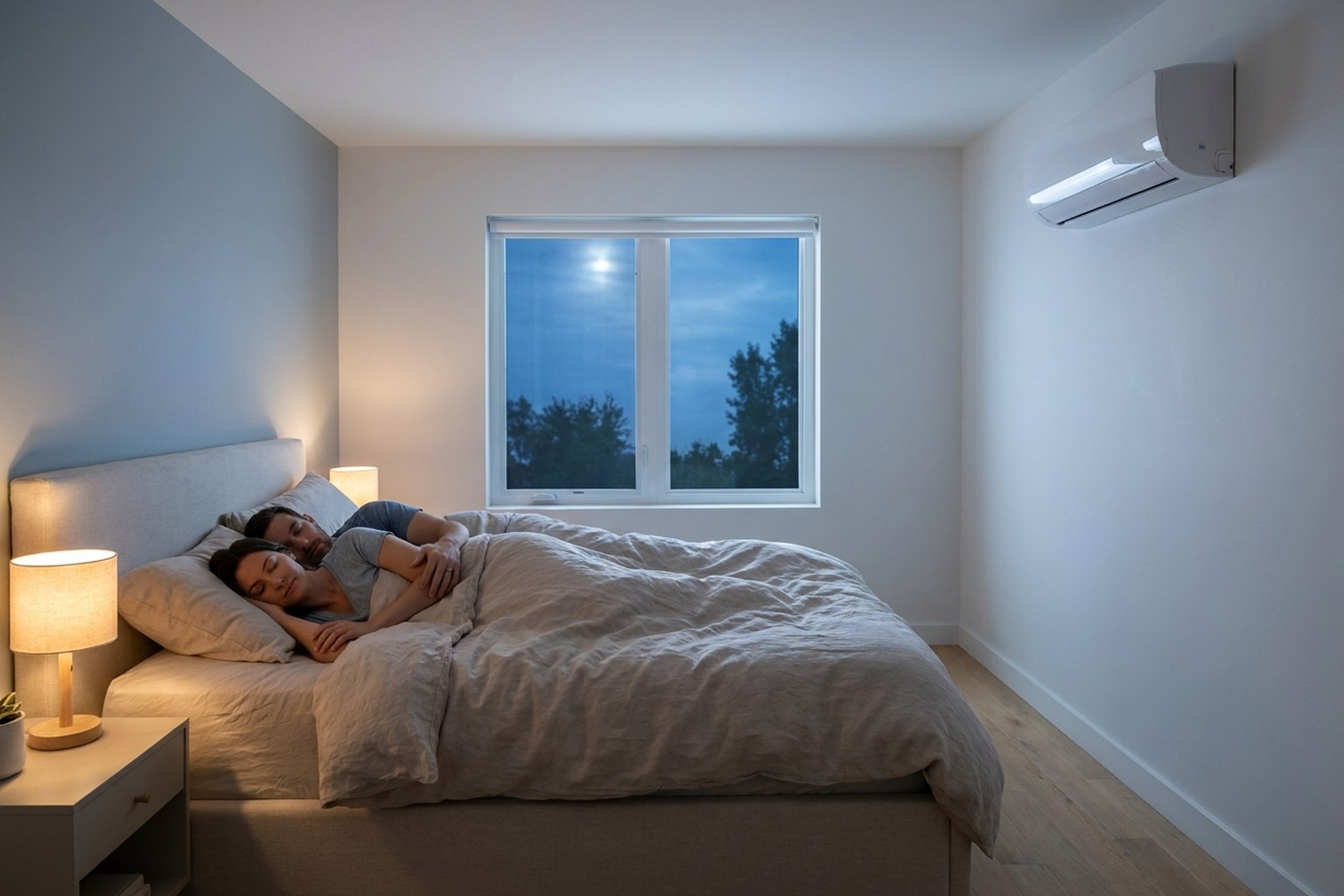
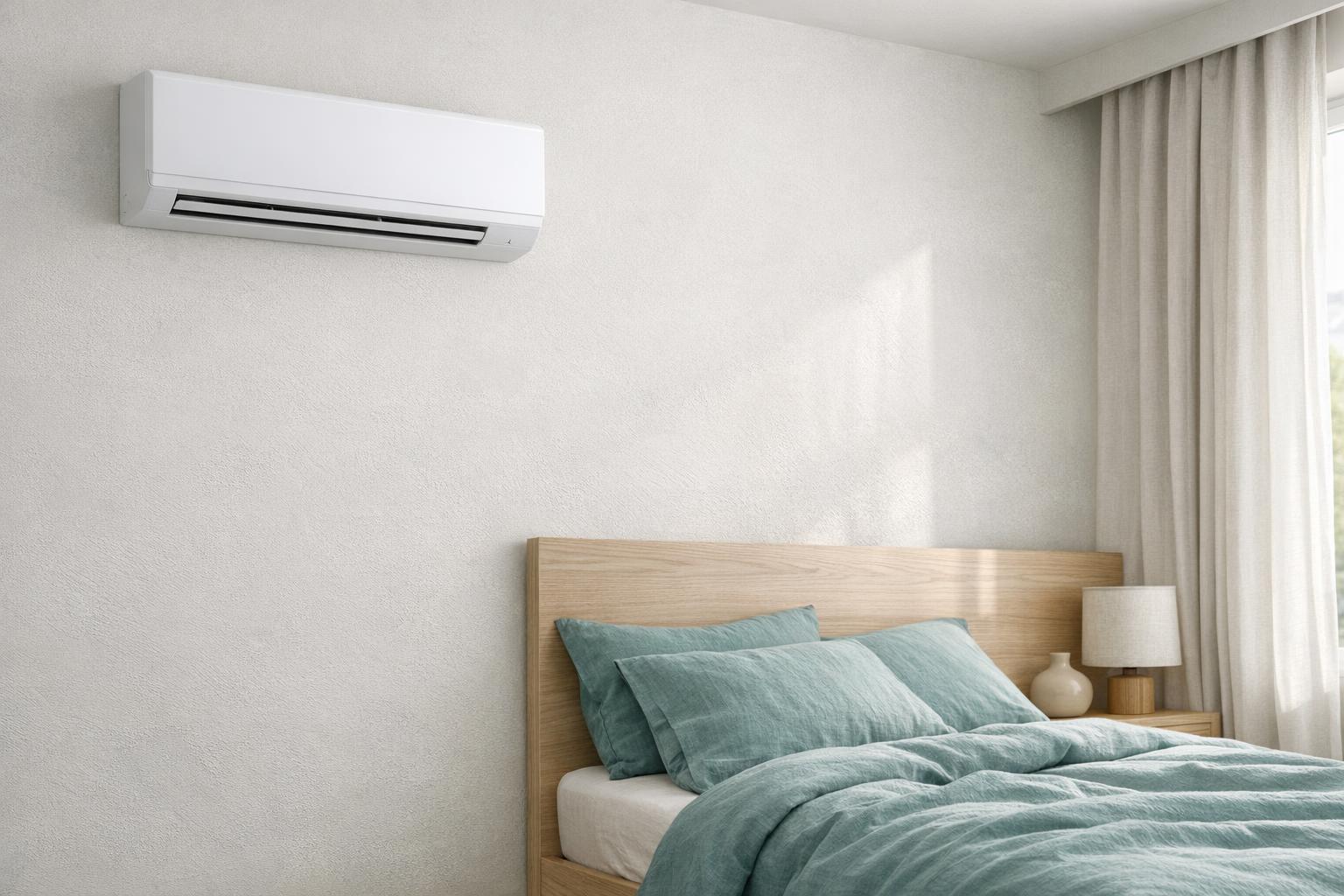
Place a mini split head high on an exterior wall, out of direct sun and away from doorways, with the clearances the manual gives (MRCOOL asks for 5.9 inches below the ceiling and 4.75 inches at the sides). Put the outdoor unit where it has open air around it, above the snow line and away from bedroom windows, walkways and dripping eaves. For noise, compare the indoor unit’s lowest-mode figure: our ranked 12,000 BTU systems list 26 to 42 dB.
Affiliate disclosureAs an Amazon Associate we earn from qualifying purchases made through links on this page. Commissions never change our ratings.
Indoor head: the rules in the manuals
| Rule | MRCOOL 4th gen | Daikin FTXC/RXC |
|---|---|---|
| Gap to the ceiling | 5.9 in | 55 mm (about 2.2 in) or more |
| Gap to side walls | 4.75 in | 50 mm (about 2 in) or more |
| Mounting height | about 78.5 in from the floor (ceilings under 9 ft) | more than 2.3 m (about 7.5 ft) |
| Distance from TV and radio | 3.3 ft (1 m) | 1 m |
| Avoid | heat sources, direct sun, doorways, obstacles | direct sun, doorways, heat or steam |
Mount on studs; MRCOOL’s template marks the holes for 16 inch stud spacing. The wall hole goes slightly downhill toward the outside so condensate drains.
Indoor head: comfort in the room
Aim the airflow along the room, not onto a bed or a desk chair. PNNL points out that a wall unit reads the temperature at its own intake near the ceiling, so the air at head and chest level can feel colder than the setpoint; some models can use a sensor in the remote or a wall thermostat instead. Leave room to open the front panel and slide out the filters, and keep the head on an exterior wall if you can: MRCOOL notes that heads on interior walls need lines run through an attic, basement or crawlspace, and possibly a condensate pump.
Outdoor unit: clearances and weather
| Side | Minimum |
|---|---|
| Above the unit | 24 in |
| In front (air discharge) | 79 in |
| Behind, ground installed | 12 in |
| Behind, on a wall bracket | 6 in |
| Left side | 12 in |
| Right side (service valves) | 24 in |
- PNNL: install well above snow height, on a stand or wall mount, and watch for vibration through the wall.
- PNNL: not under an eave where snow and meltwater fall; a unit under a deck iced up from dripping water.
- PNNL: away from walkways, where defrost water can freeze.
- DOE: on many models the outdoor unit can be up to 50 ft from the indoor unit, so there is usually a better spot than right under a window.

How to read a decibel figure
A dB number means little without the mode it was measured in. The listings in our rankings give a quiet-mode figure for the indoor unit: 26 dB sleep mode for the Mountman 12,000 BTU 110/120V, a 28 dB mute mode for the ROVSUN 12,000 BTU Wi-Fi 115V, 42 dB for the Rellytech 12,000 BTU 19 SEER2 115V, under 49 dB for the YITAHOME 18,000 BTU 21 SEER2 and 28 to 45 dBA for the ROVSUN 3-Zone 28,000 BTU (9K/9K/9K). Compare like with like: lowest mode against lowest mode, indoor against indoor. The outdoor unit is louder and has its own figure in the specifications; ask for it before you pick a spot near a neighbor’s window.
Neighbors, HOAs and local rules
Some cities and homeowner associations set noise limits at the property line or rules about where condensers may sit. Check them before the installer drills. Placing the unit on the far side from a neighbor’s bedroom, on a solid pad or bracket, and keeping the coil clean all help; ENERGY STAR notes that dirty coils make a system run longer, which also means it runs louder for longer.
Wall head, floor console or ceiling cassette
High wall heads are the most common and the cheapest, but they sense the temperature near the ceiling. PNNL points out that floor consoles avoid that problem because their intake sits closer to head and chest level, and that ducted cassettes use a wall thermostat. Ceiling cassettes are less prone than wall heads to the damp, dusty blower wheel PNNL describes. A floor console suits rooms with sloped ceilings or little high wall space; a cassette suits rooms with an accessible ceiling void.
Quiet picks from our rankings
- Mountman 12,000 BTU 110/120V: 26 dB sleep mode per the listing; rated 9.2/10.
- ROVSUN 12,000 BTU Wi-Fi 115V: 28 dB mute mode and Wi-Fi per the listing.
- ROVSUN 3-Zone 28,000 BTU (9K/9K/9K): 28 to 45 dBA across three heads per the listing.
See the full list in our best 12,000 BTU mini splits ranking, and check the route and parts in line sets and accessories.
Frequently asked questions
Where is the best place to put a mini split indoor unit?
High on an exterior wall, out of direct sun and away from doorways, with the manual’s clearances (MRCOOL: 5.9 in below the ceiling, 4.75 in at the sides) and airflow along the room rather than onto a bed.
How loud is a mini split?
Indoor units in our rankings list 26 to 42 dB in their quietest modes, depending on the model. The outdoor unit is louder; ask for its figure before placing it near windows.
How far can the outdoor unit be from the indoor unit?
DOE cites up to 50 ft on many models; the exact limit is in your installation manual (for example 73.8 ft per head on MRCOOL’s 4th-generation multi-zone).
Can a mini split outdoor unit go under a deck?
Be careful: PNNL shows a unit under a deck that iced up from meltwater dripping through, which cut its capacity. Keep it away from dripping edges or protect it with a cover.
Our rated picks
The three best-rated models of our best mini splits in 2026 ranking, from the buyer review record and the listed specs.


Product images: Amazon listings
Sources
- MRCOOL (copy hosted by InspectAPedia) — DIY Multi-Zone 4th Gen Installation & Owner’s Manual (PDF, version 06-06-2023) (consulted Nov 2026)
- MRCOOL — DIY Multi-Zone 3rd Gen quick-start installation guide (PDF) (consulted Nov 2026)
- Daikin — Installation manual FTXC-C / RXC-C R32 split series (PDF) (consulted Nov 2026)
- Pacific Northwest National Laboratory, Building America Solution Center — Ductless (Mini-Split) Heat Pumps (consulted Nov 2026)
- U.S. Department of Energy, Energy Saver (archived June 18, 2026) — Ductless Minisplit Heat Pumps (consulted Nov 2026)
- ENERGY STAR (U.S. EPA) — Maintenance Checklist (consulted Nov 2026)